Tricentis AI Workspace: The new control plane for autonomous quality engineering
AI Workspace enables enterprises to orchestrate and govern AI agents...
A green pipeline doesn’t mean your code still does what you intended. Learn how a global technology company is using AI Workspace to detect intent drift and bring continuous quality intelligence to AI-assisted development.

AI is now writing more of your code than ever. But the problem is that your test suite was built to catch errors, not to catch the difference between what an AI agent produced and what your original specification actually required.
As AI tools accelerate development velocity, the volume of code moving through pipelines is outpacing traditional quality processes. Teams aren’t just testing more code; they’re testing code generated at a speed and scale that makes it genuinely hard to know whether what shipped matches what was intended. Unlike human-authored code, AI-generated changes often optimize for plausibility rather than intent, which makes subtle behavioral drift both more likely and harder to spot during review.
Conventional CI/CD pipelines weren’t designed to solve this problem. A passing test tells you the code executed without error, but it doesn’t tell you whether the code still does what the business required when the story was written. When those two things diverge gradually across dozens of commits and hundreds of changes, pipelines stay green while meaning quietly shift. This shift is increasingly known as intent drift.

Intent drift is the gradual divergence between what code actually does and what it was originally designed to do. It’s invisible to conventional test suites because the code is technically functional, but semantically the behavior has shifted. The code no longer does what the original specification required.
This pattern is especially dangerous in AI-assisted development, where code is generated at higher velocity and volume than traditional review processes were built to handle. The gap between what was specified and what was shipped widens not through negligence but through the sheer pace of change. Standard quality gates were designed to catch errors, not drift.
As a result, a new silent category of regression lives below the surface of your metrics and only becomes visible after it reaches production.
Catching intent drift requires looking at three inputs together:
Only by considering those signals in combination can you determine whether a passing result is a genuine pass or a silent drift. At modern commit volumes, no individual reviewer or test owner can reliably reconstruct this context after the fact.
Preventing drift requires a system that preserves intent as code evolves, continuously correlates changes with outcomes, and surfaces cases where a test passes for the wrong reasons, while still involving humans at critical decision points.
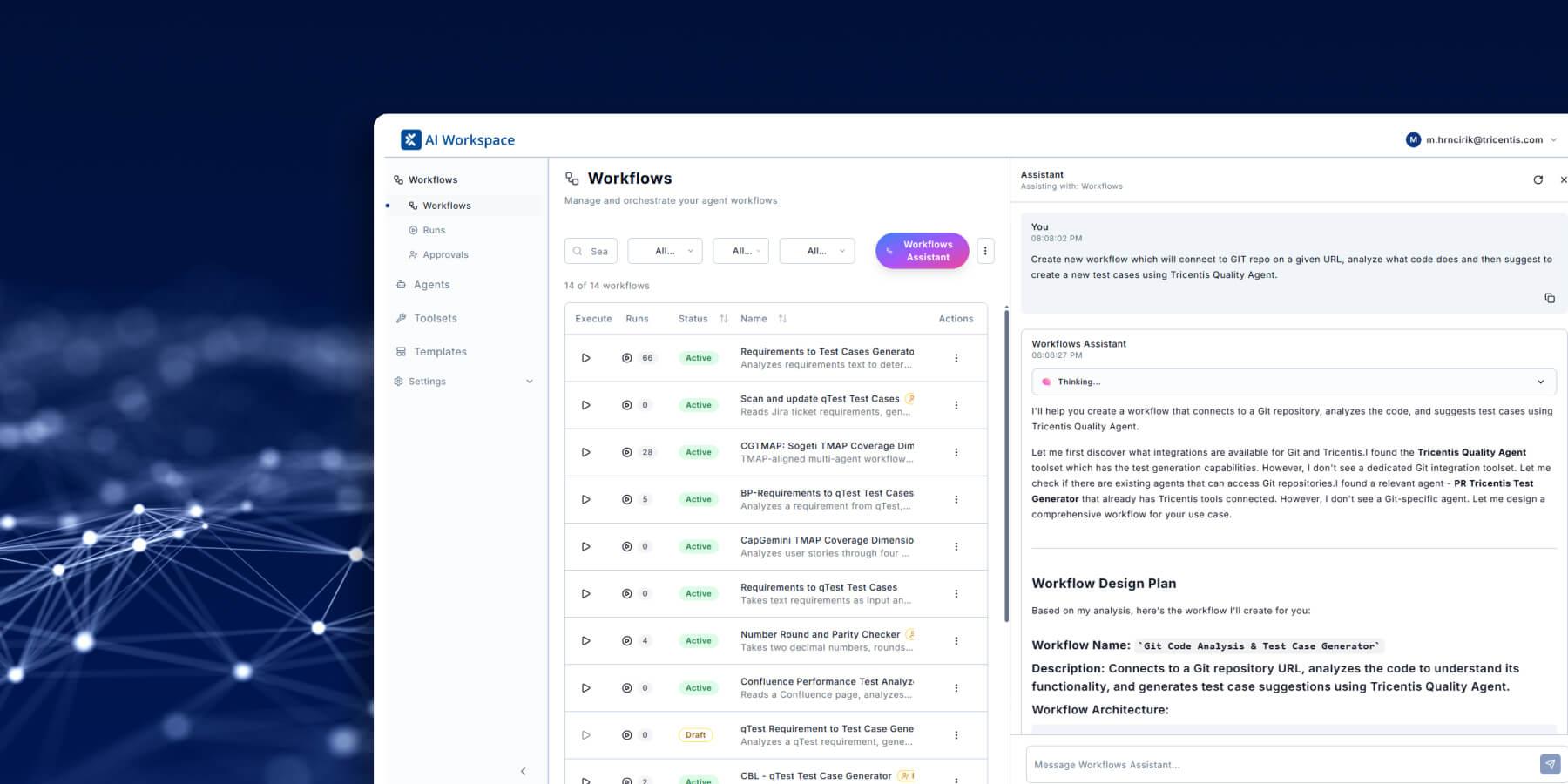
AI Workspace is a cloud-native orchestration layer for designing, deploying, governing, and scaling AI agents that perform quality engineering work across the SDLC. It connects agents, tools, and workflows into a managed system that:
AI Workspace can also integrate with systems that teams already use for versioning, reviews, and change tracking. For a closer look at how AI Workspace connects AI agents to quality workflows, and adds orchestration and governance layers that make execution manageable at scale, see our AI product release series.
A global leader in information and software solutions is among the first organizations running this pattern in a live pipeline. The organization has been building a quality engineering strategy designed to keep pace with the growing volume and velocity of AI‑generated code, while surfacing errors that traditional testing methods struggle to catch.
Rather than treating AI as isolated scripts, copilots, or experiments, Tricentis AI Workspace is used to operationalize AI as a managed, governed system.
The team created an integration that allows AI agents to compare test results with recent development activity and flag when behavior diverges from the original intent. When potential drift is detected, an agent flags that the test passes but behavior no longer matches the original specification, and that human review is required. This prevents unintended behavioral changes from progressing unnoticed.
This use case represents a meaningful shift away from coverage-based quality metrics toward intent-aware validation, where test results are evaluated in the context of what the system was originally meant to do. Tests don’t just need to pass; they need to pass for the right reasons.

AI Workspace is used alongside Tricentis Agentic Test Creation (ATC) to embed autonomous quality at nearly every step of the SDLC. During development, AI Workspace ingests requirements from the team’s existing work management system and kicks off workflows in ATC to generate test cases upfront. This way, intended behavior is captured before a single line of code is written. From there, ATC and AI Workspace work together continuously, comparing how test cases evolve as requirements move from development through final regression.
This approach makes it possible to quantify risk and detect intent drift before it reaches production, and to build targeted test cases that close the gap as soon as it appears.
Test cases are now designed around outcomes instead of tools, orchestrating agents across testing and development to create a more predictive, proactive quality strategy, while keeping humans in the driver’s seat.
By the time the team reaches full regression, risk has already been scoped and intent clarified for each test case. That feedback reaches developers early enough to actually shape the test suite rather than simply react to it.
What AI Workspace enables over time is something more significant than catching individual instances of drift. Every flagged divergence, every human review, every corrected test case contributes to what amounts to a living specification: a continuously validated map of system behavior that evolves with the codebase rather than quietly drifting away from it.
Instead of treating quality as a binary gate at release time, it becomes a continuous, specification-anchored signal from early stages of delivery. This gives engineering and QA leaders visibility into not just whether tests eventually passed, but whether the system aligns with behavior at every intended point.
For organizations managing complex, fast-moving codebases where AI is accelerating development, this kind of continuous intent validation isn’t just a QA improvement. It’s an engineering differentiator.
Most teams are asking how to maintain quality confidence as AI accelerates the pace of development. More tests won’t help if those tests can’t tell you whether the code still does what you meant, and more coverage won’t help if coverage metrics don’t surface semantic drift.
What’s missing isn’t more activity, but better insight into whether system behavior continues to align with intent as change compounds. Solving this requires a connected system where AI agents handle execution, human oversight is built into the workflow at the right points, and quality operates as a continuous signal rather than a periodic check.
Request a demo to see how AI Workspace can bring intent drift detection and autonomous quality engineering to your pipeline.