

End to end testing: Everything you should know
Learn what end-to-end testing is, why it matters, and how to apply...
Learn what data integrity is, why it matters, and how teams ensure data remains accurate, consistent, and reliable across systems.

TL;DR
Data powers every business process, workflow, application, and technology your organization depends on. When that data is inaccurate, incomplete, or inconsistent, the consequences spread across every team and decision.
Each year, data integrity issues cost organizations up to $15 million annually, and companies collectively waste trillions of dollars to find and fix data issues each year.
Testing data integrity is essential to ensuring that the quality of data in databases is accurate and that it functions as expected within specific applications.
As the volume of data stored within an organization’s IT environment continues to grow exponentially, the task of managing and testing for data integrity becomes more complex.
A report from Precisely and Drexel University’s LeBow College of Business found that 77% of organizations rate their data quality as average at best. Automated tools can help by eliminating manual processes, increasing accuracy, and reducing the cost of testing.
With automated data integrity testing tools, organizations can easily minimize downtime, improve processes, and enable data to inform decision-making.
This guide covers what data integrity is, why it matters, the different types, risks to watch out for, and practical strategies to protect and keep it reliable across your systems.
Data integrity refers to the accuracy, consistency, and reliability of data throughout its entire life cycle, from the moment it is created to the point it is archived or deleted.
When data has integrity, it accurately reflects the real-world values it was designed to represent, and it remains unaltered by unauthorized changes, system errors, or failed transfers.
The National Institute of Standards and Technology (NIST) defines data integrity as: “The property that data has not been altered in an unauthorized manner.”
This definition highlights a core principle that data should remain trustworthy from creation through storage, processing, and transit.
In practice, data integrity means that a customer address in your CRM matches what the customer actually provided, that a financial transaction in your database reflects the real amount transferred, and that a patient record in a healthcare system contains no accidental modifications.
When any of these break down, teams make decisions based on flawed information.
Data integrity applies to every industry and every system that stores or processes data. It is not limited to databases alone. It extends to spreadsheets, cloud platforms, APIs, data warehouses, and any other location where data lives.
When data has integrity, it accurately reflects the real-world values it was designed to represent, and it remains unaltered by unauthorized changes, system errors, or failed transfers.
Data integrity covers the consistency, accuracy, and correctness of data that’s stored within a database. It falls into these main categories:
Physical integrity is the protection of data from hardware failures, power outages, natural disasters, and other environmental factors that can corrupt or destroy stored information.
It depends on the infrastructure that houses your data, including servers, storage devices, and network components.
Organizations maintain physical integrity through strategies like redundant storage, regular backups, uninterruptible power supplies, and disaster recovery plans.
Without these safeguards, even perfectly accurate data can be lost or corrupted by events entirely outside of your application layer.
Logical integrity protects data from human error, software bugs, and business rule violations that can alter or corrupt information during normal operations.
While physical integrity keeps data safe from environmental threats, logical integrity keeps data accurate and consistent at the application and database level.
Logical integrity is enforced through database rules, constraints, and validation checks. It breaks down into three core subtypes: domain integrity, entity integrity, and referential integrity.
Domain integrity requires that each set of data values/columns falls within a specific permissible range. Examples of domain integrity include the correct data format, type, and data length.
Additionally, values must fall within the range defined for the system. Domain integrity may also include null status and permitted size values.
For instance, an “age” field that accepts negative numbers or a “date” field that allows text input both represent domain integrity failures. These constraints act as the first line of defense against bad data entering your systems.
Entity integrity requires that each row in a table be uniquely identified and that no duplicate records exist. Typically, entity integrity is enforced by using primary key and foreign key constraints on specific columns.
Without entity integrity, you risk storing duplicate customer records, conflicting transaction entries, or overlapping product IDs, all of which lead to unreliable reporting and flawed analysis.
Referential integrity maintains the relationships between tables. It is typically enforced with primary key and foreign key relationships.
When referential integrity breaks down, you get orphaned records, broken links between related datasets, and queries that return incomplete or misleading results. A common example is an order record that references a customer ID that no longer exists in the customer table.

Every business decision depends on the data behind it. When that data is inaccurate, incomplete, or inconsistent, the decisions it informs are flawed.
Poor data integrity affects everything from financial reporting and customer communications to supply chain operations and regulatory compliance.
The financial cost is hard to ignore. Research published in MIT Sloan Management Review estimates that bad data costs most companies between 15% and 25% of revenue.
These costs come from correcting errors, seeking confirmation in other sources, and dealing with the mistakes that follow from working with bad information.
Beyond the direct financial impact, poor data integrity reduces trust. When teams cannot rely on the data in front of them, they second-guess reports, duplicate verification efforts, and slow down decision-making.
Studies find that 67% of organizations don’t fully trust their data for decision-making. That lack of trust creates friction across every department.
This trust problem becomes a bigger issue as organizations invest in AI. Carlie Idoine, VP Analyst at Gartner, puts it plainly:
“If our organizations don’t trust AI, and they don’t trust the data, how can they trust the outcomes?”
Data integrity also plays a direct role in regulatory compliance. Industries like healthcare, finance, and manufacturing operate under strict data governance requirements from frameworks including HIPAA, SOX, and GDPR. Inaccurate or incomplete records can lead to audit failures, fines, and reputational damage.
Organizations that handle data integrity as a priority make faster, more confident decisions, reduce operational waste, and build a stronger foundation for AI and analytics initiatives that depend on trustworthy data.
These three terms are often used interchangeably, but they refer to different things. Understanding where they overlap and where they don’t helps teams use the right strategies.
This is the accuracy, consistency, and reliability of data across its entire life cycle. It covers how data is created, stored, maintained, and transferred, and whether it remains unaltered by unauthorized changes or system errors.
Data quality measures how well a dataset meets the specific needs of its intended use. It evaluates dimensions like completeness, accuracy, timeliness, and relevance.
A dataset can have high integrity (it hasn’t been tampered with) but low quality (it’s outdated or missing key fields).
Data security protects data from unauthorized access, theft, and malicious attacks. It involves encryption, access controls, firewalls, and authentication protocols.
Security prevents external and internal threats from compromising your data, but it does not guarantee that the data itself is accurate or complete.
Here’s a simple way to think about the relationship: data security keeps the wrong people out, data integrity keeps the data trustworthy, and data quality makes sure the data is useful.
All three work together, but they require different practices and different teams. A strong security posture won’t fix duplicate records or incomplete fields.
High-quality data doesn’t mean much if someone can alter it without detection. And data with integrity still needs to be relevant and timely to drive good decisions.
Teams or organizations that treat these as separate but connected disciplines build a stronger overall data foundation. Neglecting any one of the three creates gaps that affect reporting, compliance, and decision-making.
Data integrity doesn’t fail all at once. It breaks down gradually through a mix of human mistakes, technical failures, and process gaps. Understanding the most common risks helps teams catch problems early and put the right controls in place.
A single mistyped digit in a financial spreadsheet or a duplicated customer record can cascade into flawed reports and bad decisions.
This is the most frequent cause of data integrity issues. Incorrect data entry, accidental deletions, duplicate records, and copy-paste mistakes happen daily in every organization.
A single mistyped digit in a financial spreadsheet or a duplicated customer record can cascade into flawed reports and bad decisions. The challenge is that these errors are often invisible until they cause problems down the line.
Transfer errors occur when data is moved between systems, databases, or platforms. During migrations, API syncs, or ETL processes, data can be truncated, reformatted, or dropped entirely.
A field that is stored as a date in one system might convert to plain text in another, breaking any logic that depends on it. These errors are especially common during large-scale cloud migrations or ERP transitions.
Security breaches can corrupt, expose, or destroy data. Whether through ransomware, unauthorized access, or insider threats, a breach is both a security problem and a data integrity problem. Once data has been accessed or altered without authorization, every record touched by the breach becomes unreliable.
These bugs can silently modify data without any user action. A flawed update, a misconfigured integration, or a poorly tested release can overwrite values, break validation rules, or introduce inconsistencies that go undetected for a long time.
Failures such as disk corruption, server crashes, and storage degradation can render data incomplete or inaccessible. Without redundant systems and tested backup procedures, a single hardware failure can result in permanent data loss.
Regulations like HIPAA, SOX, and GDPR add another layer of risk. When organizations fail to follow data-handling rules around storage, retention, access, and privacy, they face penalties, audit failures, and reputational damage.
Regulatory non-compliance is both a cause and a consequence of poor data integrity.
Lack of standardization across teams and systems is an often overlooked risk. When departments define, format, or store data differently, merging that data for reporting or analytics produces conflicts and inconsistencies.
Without shared data standards, even accurate individual datasets become unreliable when combined.
Maintaining data integrity requires a combination of technical controls, organizational habits, and ongoing monitoring. No single tool or policy will solve the problem on its own. Instead, teams need layered practices that catch issues at different points in the data life cycle.
The cheapest place to fix a data error is before it enters your system.
The cheapest place to fix a data error is before it enters your system. Input validation, dropdown menus, required fields, and format restrictions prevent common entry mistakes. If an “email” field accepts any text string without basic format checks, bad data will get through.
Role-based access controls limit who can view, edit, or delete records. Not every team member needs write access to every database. Restricting permissions reduces the chance of accidental changes and makes it easier to trace issues when they occur.
Every change to critical data should be logged with a timestamp, the user who made the change, and the previous value. Audit trails make it possible to identify when and where integrity broke down, which is especially important for regulated industries.
Backups protect against hardware failure, ransomware, and accidental deletion. But a backup is only useful if it actually works. Organizations should test their restore process on a regular schedule, not just assume it will work when needed.
When the sales team defines “active customer” differently than the finance team, reports built from both datasets will conflict. Shared data dictionaries and naming conventions prevent these inconsistencies before they become reporting problems.
Scheduled checks that compare data across systems, flag duplicates, and verify completeness help catch issues before they affect decisions. Manual spot checks combined with automated monitoring give teams the broadest coverage.
Manual data handling increases the chance of human error at every step. Automated validation, transformation, and reconciliation tools reduce that risk while freeing teams to focus on higher-value work.
Data integrity testing is a manual or automated process that evaluates the quality and reliability of data in databases and data warehouses, confirming that records are unaltered, free from corruption, and conform to defined business rules.
Testing verifies that data stored across your systems is accurate, complete, and consistent.
Testing typically covers several key dimensions:
This ensures that the data objects correctly represent the values they’re expected to model. A shipping address that points to the wrong location or a price field that reflects an outdated value are both accuracy failures.
Completeness checks that no required data is missing. Incomplete records, such as customer profiles without email addresses or transaction logs without timestamps, create gaps that affect reporting and analysis.
Conformity validates that data follows or conforms to a specific format, matches business rules, and meets user expectations. Dates stored in mixed formats across tables are a common conformity failure.
This verifies that the same data stored in different systems does not conflict. A customer name that appears as “John Doe” in your CRM but “J. Doe” in your billing system is a consistency issue.
Timeliness determines whether data is current enough to be useful. Stale data can lead to decisions based on outdated information.
Uniqueness confirms that no duplicate records exist for a given set of columns. Duplicate entries inflate metrics, distort analysis, and waste storage.
Organizations that test across all of these dimensions get a more complete picture of their data health. Relying on one or two checks leaves blind spots that can affect downstream decisions and reporting.

Traditional data integrity testing requires teams to manually write test scripts, define validation rules, and maintain checks as data sources and schemas change.
This approach works at smaller scales, but it struggles to keep pace as organizations manage growing data volumes across more systems, platforms, and pipelines.
Agentic AI changes this by introducing AI agents that can plan, execute, and adapt testing tasks with minimal human direction.
Instead of writing individual test scripts for every table and relationship, teams describe what they need validated in plain language, and AI agents generate and run the appropriate checks.
When data schemas change or new sources are added, agents can detect the shift and adjust their testing logic without waiting for someone to update a script.
For data integrity specifically, agentic AI can automate reconciliation testing between source and target systems during migrations, continuously monitor data quality metrics across pipelines, flag anomalies in real time before they reach downstream reports, and adapt validation rules as business logic changes.
This shift matters because data integrity is not a one-time check. It requires continuous monitoring across systems that are constantly changing. Agentic AI makes that level of coverage possible without scaling your team at the same rate as your data.
The organizations seeing the most value from agentic AI in testing are those that pair it with strong data governance. AI agents can move fast, but they still need clear rules, defined ownership, and audit trails to operate responsibly.
Tricentis offers a new and fundamentally different way to manage software testing and data integrity testing. The Tricentis platform is AI-driven, fully automated, and codeless.
Tricentis offers Agile test management and advanced software test automation that’s optimized to support 160+ technologies, including solutions for testing with Jira and for SAP, ServiceNow, Oracle, Snowflake, and Salesforce testing.
As the industry’s #1 Continuous Testing platform, Tricentis offers solutions that top any test automation tools list.
Tricentis Data Integrity offers a powerful solution for eliminating data integrity issues before they can cause harm.
Offering end-to-end automation, Tricentis covers everything from the integrity of data as it enters a system to the accuracy of integrations, transformations, and migrations.
The platform tests both structured and unstructured data from any source, including commercial, homegrown, legacy, and modern cloud-based technologies.
Tricentis Data Integrity automated testing tools provide:
With Tricentis Data Integrity testing tools, organizations can:
Tricentis is also leading the shift toward agentic AI in software testing. Through remote Model Context Protocol (MCP) servers and Tricentis Agentic Test Automation, AI agents can now interact directly with enterprise testing tools, generate test cases from natural language, and adapt to changing environments.
Early adopters have reported up to 85% time savings in test creation.
See how Tricentis enables AI-driven data integrity testing.
Relying on one or two checks leaves blind spots that can affect downstream decisions and reporting.
Data integrity is the foundation of trustworthy reporting, sound decision-making, and reliable AI. Without accurate, consistent data flowing through your systems, every downstream process is at risk.
The organizations that treat data integrity as an ongoing discipline rather than a one-time project are the ones that make faster decisions, reduce operational waste, and get more value from their technology investments.
Whether you are managing a cloud migration, scaling analytics, or preparing your data for AI initiatives, getting data integrity right is where it all starts.
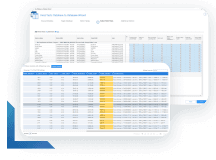
Learn more about driving better business outcomes with high-quality, trustworthy data.
Learn more about driving better business outcomes with high-quality, trustworthy data.
Data integrity is the accuracy, consistency, and reliability of data throughout its entire life cycle. It means data remains unaltered by unauthorized changes, system errors, or failed transfers from the moment it is created to the point it is archived or deleted.
Data integrity covers whether data has remained accurate and unaltered across its life cycle. Data quality measures whether data is fit for a specific use, evaluating dimensions like completeness, timeliness, and relevance.
A dataset can have high integrity (it hasn’t been tampered with) but low quality (it’s outdated or missing key fields). Data quality is one component of the broader data integrity picture.
Human error is the most frequent cause, including incorrect data entry, accidental deletions, and duplicate records.
Other common causes include transfer errors during migrations, software bugs that silently modify data, hardware failures, security breaches, and a lack of standardization across teams and systems. These issues tend to build up over time when left unaddressed.
Data integrity testing evaluates stored data against several dimensions, including accuracy, completeness, consistency, conformity, timeliness, and uniqueness.
Testing methods include pre-screening checks, reconciliation testing between source and target systems, profiling for business logic validation, and BI report testing. Teams can run these tests manually or through automated tools that provide continuous monitoring.
AI and ML models are only as reliable as the data they are trained on. Inaccurate, inconsistent, or incomplete training data leads to biased predictions, flawed recommendations, and unreliable outputs. Organizations that invest in data integrity before deploying AI initiatives see stronger model performance and greater trust in AI-driven decisions.