

An introduction to agile test management
Learn how to define and implement an agile test management strategy...
What is agile software testing? Learn its principles, benefits, and how testing fits into Agile development and continuous delivery.

TL;DR
As a growing number of organizations have adopted Agile methodology, testers and quality assurance (QA) staff have struggled to keep up.
Software testing was once a sequential task performed at the end of a development process. But with the accelerated pace of Agile methodology, these traditional testing timelines no longer work.
In Agile environments, testing happens continuously, alongside development, not after it. Testers, developers, and business analysts work together within each sprint to validate and make sure that software meets requirements before it moves forward.
This means testers need different methods, different tools, and a different mindset than what traditional processes used to require.
This post covers the principles, methods, and strategies behind Agile software testing, along with common challenges, and how agentic AI is starting to reshape how Agile teams test software.
Agile software testing is a testing practice where QA activities run continuously throughout each sprint rather than in a separate phase after development is complete.
It aligns testing with the iterative, incremental nature of Agile development so that quality is built into the product right from the start.
In a traditional setup, testers receive a finished build, run their test cases, log defects, and send everything back to developers. This cycle can take weeks.
Agile software testing removes that issue by embedding testers directly into the development team. They participate in sprint planning, write test cases as features are being defined, and validate working software within the same iteration that it was built.
Agile software testing is not a single technique or tool. The approach it uses is one that combines multiple test methods, continuous feedback loops, and shared ownership of quality across the entire team.
This results in faster defect detection, shorter release cycles, and software that closely reflects what users actually need.
Agile software testing is a testing practice where QA activities run continuously throughout each sprint rather than in a separate phase after development is complete.
To keep up with the pace of Agile development, QA staff must adopt a different approach to testing. The following principles define how testing works in an Agile environment:
Agile software testing takes place throughout the development life cycle, not at the end of it. Every sprint includes its own testing activities, from unit tests during development to acceptance tests before a sprint closes. Testing is a constant activity, not a phase that teams enter and exit.
Continuous testing gives teams a real-time view of software quality. When a defect surfaces during development rather than three weeks after a release, the fix is faster, cheaper, and far less disruptive.
In Agile methodology, testing is no longer the sole responsibility of a dedicated QA team. Developers write unit tests for their own code.
Business analysts help define acceptance criteria. Product owners validate that features match user expectations. Everyone contributes to quality.
This shared ownership makes defects less likely to slip through because multiple people with different perspectives are examining the same work. It also cuts down on the friction that can build up when developers and testers work in silos instead of side by side.
Continuous testing generates continuous feedback. Developers learn about issues and performance defects within the same sprint, while context is still fresh.
Business stakeholders contribute during each iteration rather than waiting until a user acceptance phase weeks or months later.
Early feedback is one of the most valuable outcomes of Agile testing. It allows teams to correct errors quickly, reduce rework, and keep requirements aligned with actual business needs.
When defects are caught and fixed within a single sprint, they don’t pile up. The codebase stays simpler and more maintainable because technical debt is addressed incrementally rather than deferred to some future cleanup effort that may never happen.
Clean code also makes future testing easier. A well-maintained codebase produces fewer false positives in automated test suites and makes it simpler to isolate the root cause when something breaks.
Agile testers work in constant communication with developers, product owners, and end users. This goes beyond status updates in a standup meeting.
Testers pair with developers to review test coverage, collaborate with business analysts on acceptance criteria, and sometimes work directly with customers to understand real-world usage patterns.
This level of collaboration produces better test coverage and a shared understanding of what “done” actually means for any given feature.


Agile testing follows a repeatable cycle within each sprint. While the specific activities vary by team, most Agile testing life cycles move through five phases.
The sprint begins with planning, and testers should be involved too. During this phase, the team reviews user stories, defines acceptance criteria, and identifies which stories carry the most risk.
Testers use this information to determine what needs to be tested, how deeply, and which test types apply.
Teams often use the Agile testing quadrants, a framework that categorizes tests along two axes (technology-facing vs. business-facing, and supporting the team vs. critiquing the product) to guide these decisions.
Once stories are defined, testers write or update test cases to match the new acceptance criteria. In many teams, this happens alongside development rather than after it.
Automated test scripts are created or updated in parallel so that they are ready to run as soon as working code is made available.
As developers complete features, testers execute test cases against working builds. This includes both automated checks (unit tests, integration tests, regression suites) and manual activities like exploratory testing.
The goal is to confirm that each feature works within the sprint it was built in, not in a later cycle.
When tests uncover defects, testers log them immediately and work with developers to prioritize fixes within the same sprint. Short feedback loops mean developers still have full context on the code they wrote, which makes fixes faster and more accurate.
At the end of the sprint, the team reviews what was tested, what was missed, and what can be improved.
Testers contribute data on defect trends, test coverage gaps, and areas where automation could replace repetitive manual effort. These insights feed directly into the next sprint’s planning phase, closing the loop.
The Agile testing life cycle is designed to keep quality visible at every stage of development, not hidden in a report that becomes visible weeks after the code was written.
Testers contribute data on defect trends, test coverage gaps, and areas where automation could replace repetitive manual effort.
Agile teams use different testing methods depending on what they’re building and how much risk is involved. Here are some of the most common methods:
BDD testing starts by ensuring that developers, testers, and business analysts have a shared understanding and are all clear on the required features.
Testers then write scenarios that contain information on how a certain feature should behave in different situations and with various inputs.
Automated tests are conducted to determine how the software performs, and developers build software functionality designed to make the scenarios work. BDD keeps everyone aligned on expected behavior before a single line of code is written.
ATDD testing brings together customers, developers, and testers to review the software from the customer’s perspective.
The team defines acceptance criteria up front, and those criteria become the basis for test cases. ATDD gives developers a clearer understanding of what customers expect and how the software will be used.
Exploratory testing is typically a manual test without scripts.
Testers create tests as they explore the product, and create new tests based on what they have learned from previous tests.
This method is good for revealing bugs and defects that scripted tests and other testing methodologies miss, because it relies on the judgment and curiosity of a human rather than a fixed checklist.
Because exploratory testing relies heavily on the creativity of testers, results can be somewhat uneven.
Session-based testing adds structure to exploratory testing to ensure that all areas of the product are thoroughly tested. Testers work within defined time blocks (sessions), each with a specific mission or area of focus.
Traditional software testing mirrors traditional Waterfall software development.
Traditional software testing mirrors traditional Waterfall software development. To understand Agile software testing, it’s helpful to compare Waterfall vs. Agile testing processes.
In Waterfall testing, testing takes place once the development phase is complete. For any changes to be made, the project must start again from the beginning.
User acceptance tests are performed at the very end of the project. In Agile testing, testing begins at the start of the project. Defects can be fixed along the way.
Every iteration has its own tests, and regression tests can be run whenever new code is written or released. User acceptance tests are performed at the end of every sprint, ensuring that customers are highly involved in the development process.
The Waterfall testing process is highly structured and involves detailed descriptions of the testing process.
Elaborate documentation is required to guide QA staff through their tests. In Agile testing, the process is lighter, involves less up-front planning, and there is far less documentation required.
In Waterfall testing, testers and developers work separately, and developers are not involved in reviewing requirements and planning the testing process. In Agile testing, testers are in constant communication with developers and they jointly analyze requirements and testing plans.
Waterfall testing works best for projects with fixed requirements that are unlikely to change. Agile testing is a better fit when requirements shift often and teams need to deliver working software in short cycles.
Having the right methods is only part of the process. Teams also need practical strategies to make Agile testing work day to day.
The earlier a bug is found, the cheaper it is to fix. Start writing test cases during sprint planning, not after development is finished. Run tests continuously so issues surface while the code is still fresh.
As the product grows, the number of things to retest after every change grows with it. Automating regression tests saves hours of repetitive manual work and gives teams fast feedback on whether new code broke anything.
Automating regression tests saves hours of repetitive manual work and gives teams fast feedback on whether new code broke anything.
Every user story should have specific, testable acceptance criteria before development begins. When the whole team agrees on what a complete feature looks like, there are fewer surprises during testing and fewer arguments about whether a feature is ready to ship.
Not every feature carries the same level of risk. Focus testing effort on the areas that matter most, like features that handle payments, store sensitive data, or serve the highest number of users. Lower-risk features can get lighter coverage.
Agile does not mean no documentation at all. It means writing just enough to keep the team aligned without slowing anyone down. Short test summaries, acceptance criteria in user stories, and automated test results often replace the heavy test plans used in Waterfall projects.
Shifting left means involving testers earlier in the development process. When testers review requirements, join design discussions, and write test cases alongside developers, defects can be caught before code is even written.
Martin Fowler notes that:
“Continuous Integration doesn’t get rid of bugs, but it does make them dramatically easier to find and remove.”
Agile testing works best when the whole team treats quality as a shared responsibility, not something that belongs only to QA.
Agile software testing gives development teams several practical advantages over traditional testing approaches.
Because testing happens throughout each sprint, bugs are found while the code is still fresh. Developers can fix issues quickly instead of revisiting work from weeks ago. This leads to faster releases and fewer surprises in production.
Fixing a bug early in development costs a fraction of what it costs to fix after release. Agile testing catches problems sooner, which reduces rework and keeps overall testing costs down.
Agile testing adapts easily when requirements change mid-project. Since tests are written in short cycles, the team can adjust test cases to match new priorities without scrapping weeks of work.
User acceptance tests happen at the end of every sprint, not just at the end of the project. This keeps customers involved and gives the team frequent input on whether the product is heading in the right direction.
Testers work side by side with developers and product owners, which helps everyone feel more invested in the quality of what they’re building.
The close collaboration that Agile testing requires creates a more connected workplace. Testers work side by side with developers and product owners, which helps everyone feel more invested in the quality of what they’re building.
When customers give feedback throughout the process instead of only at the end, the final product is more likely to match or possibly exceed their expectations.
Agile testing has clear benefits, but it comes with its own set of difficulties. Knowing what to expect helps teams prepare in advance.
Sprints move fast, and there is not always enough time for thorough test planning. Testers often have to balance speed with coverage, deciding what to test deeply and what to test lightly based on risk.
Agile testing welcomes change, but frequent shifts in requirements can make test cases outdated before they are even executed. Teams need to update tests quickly and stay in close contact with product owners to avoid testing against the wrong criteria.
As the product grows, so does the list of features that need retesting after every change. Without strong test automation, regression testing can become a bottleneck that slows down the whole sprint.
Using Agile testing means that teams depend on constant communication. When teams are spread across time zones or working remotely, it’s harder to keep testers, developers, and business stakeholders aligned.
Daily standups and shared dashboards help, but they do not fully replace being in the same room.
Agile teams sometimes share test environments with other teams or run tests against unstable builds. This could lead to false failures and wasted time investigating issues that have nothing to do with the code being tested.
Not everything can or should be automated. Teams need to figure out which tests are worth automating and which ones still need a human eye. Getting this balance wrong means either spending too much time on manual work or missing defects that scripts cannot catch.
Agile testing challenges are manageable, but only when teams plan for them instead of discovering them mid-sprint.
Agile testing depends on speed, short feedback loops, and the ability to adjust quickly.
Agile testing depends on speed, short feedback loops, and the ability to adjust quickly. Agentic AI fits naturally into that model because it can take on testing tasks autonomously, without waiting for a human to script every step.
Agentic AI refers to AI systems that can independently plan, execute, and adapt actions towards a goal with minimal human direction.
In the context of Agile testing, this means AI agents that can create test cases from user stories, decide which tests to run based on code changes, and update tests automatically when requirements shift mid-sprint.
Here’s how it works in practice across common Agile testing activities:
Instead of testers manually writing cases for every new user story, an AI agent can read acceptance criteria and generate test cases on its own. This frees testers to focus on edge cases and exploratory work that requires human judgment.
When time is short in a sprint, teams need to decide which tests matter most. Agentic AI can analyze recent code changes, defect history, and risk areas to recommend which tests to run first, helping teams get the most value out of limited testing time.
One of the biggest pain points in Agile testing is keeping tests up to date as the product changes. AI agents can detect when a test has broken because of a UI change or a shifted workflow and fix the test automatically, without a tester stepping in.
As sprints add new features, the regression suite grows. Agentic AI can identify which parts of the regression suite are relevant to a given code change and run only those tests, cutting execution time without sacrificing coverage.
Teams that already follow Agile testing practices are well-positioned to benefit from agentic AI because the short cycles, clear acceptance criteria, and tight collaboration that Agile requires give AI agents the structured context they need to work well.
Tricentis is an AI-driven testing platform that helps Agile teams test faster, smarter, and with less manual effort. Offering Agile test management and advanced software test automation tools, Tricentis uses AI to turn testing from a bottleneck into a driver of speed and quality.
With over 3000 customers around the world, Tricentis is the leader in enterprise test automation.
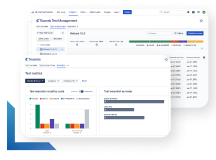
Part of the Tricentis platform, Tricentis qTest offers a suite of Agile software testing tools designed to improve efficiency and ensure collaboration.
qTest accelerates digital transformation with testing solutions that help organizations prioritize quality, increase speed to market, and develop more reliable software.

Tricentis qTest includes a comprehensive suite of tools:
Additionally, the Tricentis platform offers tools for data integrity testing, performance testing, test automation, smart impact analysis, Jira test management, ServiceNow testing, and Salesforce testing.
Tricentis also supports agentic AI workflows through Model Context Protocol (MCP) integrations across its product line, giving AI agents direct access to test management, test automation, and performance testing tools.
See how Tricentis enables AI-driven Agile testing with qTest.
Learn how to supercharge your quality engineering journey with our advanced testing solutions.
Learn how to supercharge your quality engineering journey with our advanced testing solutions.
The Agile methodology is a set of principles for building software in short, iterative cycles called sprints.
Teams deliver working software in small increments, gather feedback frequently, and adjust plans along the way. Agile puts more weight on collaboration and working products than on rigid planning and heavy documentation.
Agile testing fits into CI/CD by running automated tests every time new code is committed. Unit tests, integration tests, and regression tests execute automatically in the pipeline, giving developers immediate feedback on whether their changes introduced any problems.
This keeps the codebase stable and allows teams to release with confidence at the end of each sprint.
An Agile test plan is lighter than a traditional test plan. It typically includes the test scope for the current sprint, acceptance criteria for each user story, the types of testing to be performed, and any known risks.
Rather than documenting everything up front, Agile test plans are updated as the sprint progresses and requirements become clearer.
Agile testers need a mix of technical and communication skills. On the technical side, familiarity with test automation tools, CI/CD workflows, and basic scripting helps.
On the communication side, Agile testers need to collaborate closely with developers and product owners, ask good questions during sprint planning, and adapt quickly when priorities change.